
Every team running paid UA for subscription apps almost immediately runs into the concept of “web funnels.” The core idea is simple: you add a web layer between the ad and the product, so the user goes through the onboarding and payment before they ever reach the product.
In-app, web2app, and web2web funnels have different economics, different friction points, and different optimization levers. This is a breakdown of how each funnel actually works, why web-first funnels have become the dominant pattern in subscription UA on Meta, and what we learned running these at Talaboos.
TL;DR
In-app funnels keep the entire experience inside the product: the user installs the app, goes through in-app onboarding, hits an in-app paywall, and pays through the store. Web2app funnels move onboarding and payment to the web before the user ever installs anything, then redirect them to the app after paying. Web2web funnels run everything on the web (onboarding, payment, and the product itself) with no redirection to the store at any point. Web-first approaches (web2app and web2web) dominate paid UA today because they produce cleaner attribution signal, faster iteration cycles, and better ROAS in most subscription verticals.
In this article, we will cover
- The exact difference between in-app, web2app, and web2web funnels
- Why web-first funnels work so well for paid UA; Meta, TikTok, and Google
- Real advantages and hidden costs you need to plan for
- How to launch your first tests quickly
- The Talaboos case: what we tested, which platform we chose, and what we decided based on results
From click to checkout: in-app, web-to-app & web-to-web flows
A standard user journey looks like this.
In-app funnel
The user clicks an ad, lands on the store, installs the app, goes through in-app onboarding, reaches an in-app paywall, and pays through the store. Apple or Google handles the transaction and takes their commission. Attribution post-iOS 14.5 runs through SKAdNetwork, which is aggregated, delayed, and gives ad networks a limited signal to optimize on. Everything (acquisition, conversion, and retention) happens inside the app ecosystem.
The idea behind the web funnels is simple: the user goes through onboarding, pays, and only after that gets access to the product.
Web-first funnel
Step 1. Click on an ad
The click takes the user into the funnel.
Step 2. Onboarding
Instead of going straight to the product, the user lands on a mobile web page. At this step teams usually do three things:
- carry the creative through (same angle, same pain, same promises)
- collect signals about behavior and traffic source on the web side
- guide the user to the next step and then payment
The landing here is a part of the funnel. It guides the user through the onboarding flow and nudges them toward action.




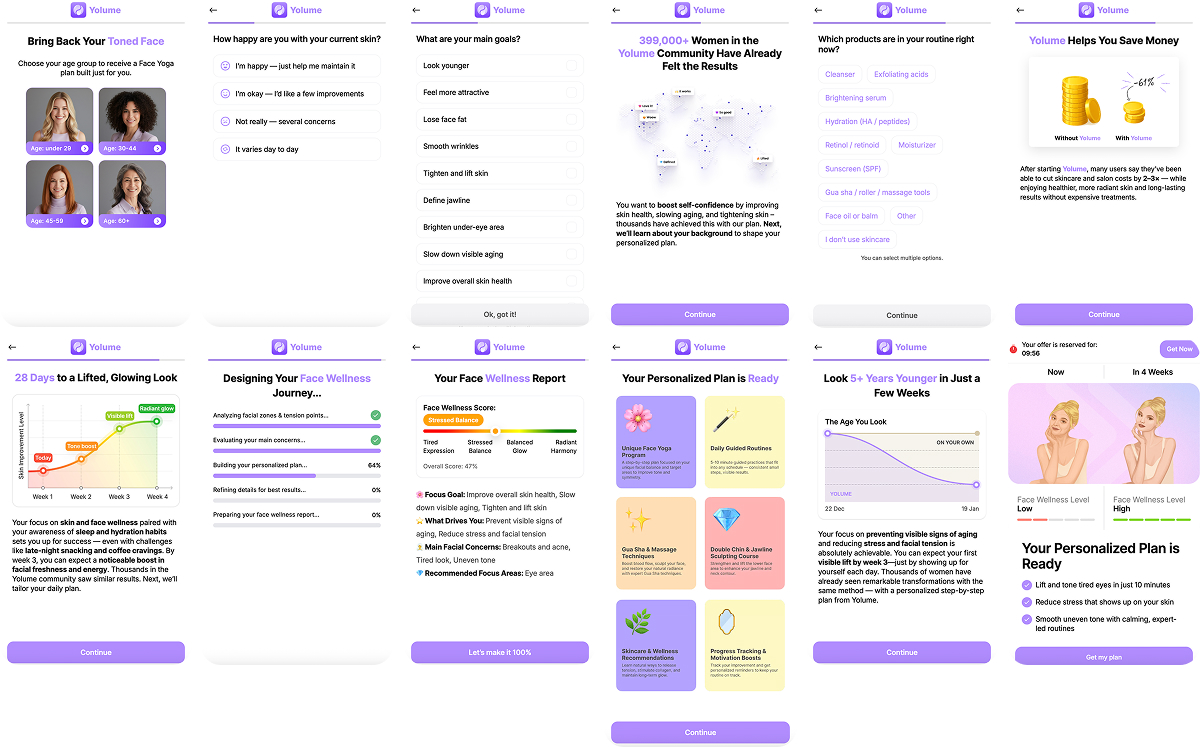
Right now one of the most common patterns is interactive quizzes that ask users questions about their goals and needs. Along the way, they get quick feedback and see how the system maps out a plan that fits them. That builds trust and makes the experience feel personalized. It shows the end goal the user is working toward and creates the sense that the product knows exactly how to get them there, which directly affects conversions.
More recently, teams have also started using interactive, game-like mini-flows with quickly changing mechanics as an alternative to quizzes. The goal is the same: keep users engaged, communicate the product’s value before they ever access it, and smoothly guide them toward paying for the first subscription period.
Step 3. Payment
Payment happens on the web, giving you more control over the paywall and checkout and helping you sidestep store fees.
Step 4. Redirect
After payment, the user is redirected either to the product itself (web-to-web) or to the store to install the app (web-to-app). There are different ways for the user to get access to content: auto-login via a deeplink and an access parameter, email auth where a magic link is sent, or creating an account during onboarding that is then used in the product.
Why this fits paid UA (Meta, TikTok, Google)
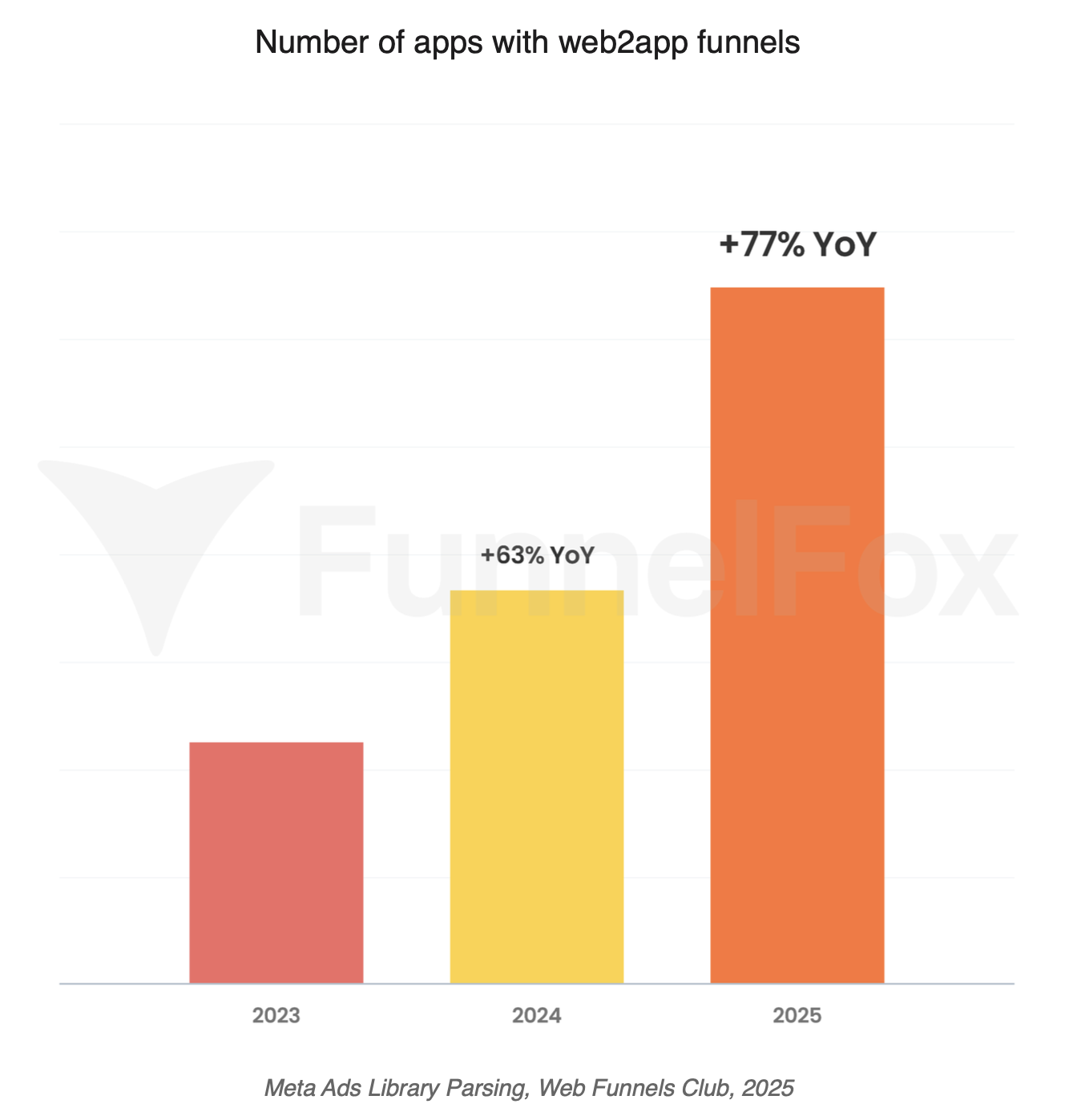
The number of apps running web2app funnels grew 77% year-over-year as of 2024, with health and fitness still leading by volume but the pattern spreading steadily into finance, relationships, and personal development.
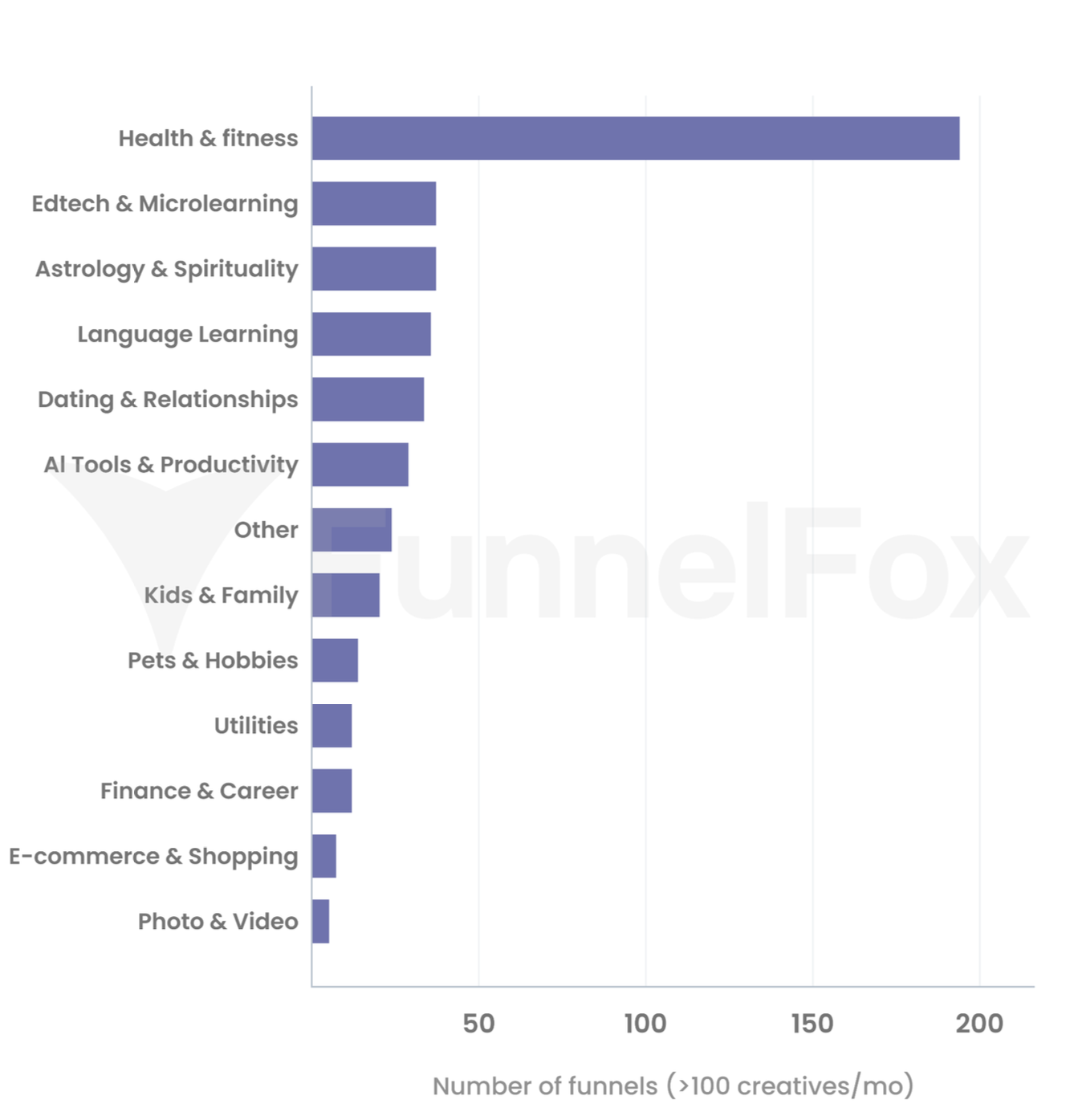
“Health & fitness leads by a wide margin. The simple reason is that web-to-app funnels took off there first. There’s still plenty of room to build, especially in money, relationships, and family, plus health-adjacent sub-niches where demand is massive and still underserved.”
David, Head of UA at Talaboos
Web2app is usually driven by the following reasons.
- More control over attribution and signal. After iOS 14.5 and the mass shift to ATT, the “click → action” link became less predictable. Ad networks optimize on the signals they receive, so fewer signals means worse optimization, higher CPAs, and less predictable ROAS. Web events work differently: when payment happens on the web, it can be tracked and passed back to ad networks more directly. In practice this tends to stabilize campaign learning phases and reduce variance in early results, particularly on Meta.
- Web payments give you flexibility. You get more control over paywall structure and monetization scenarios that are difficult or expensive to run inside the store. Removing the 15-30% commission changes unit economics meaningfully at scale, which affects how much you can afford to spend on acquisition.
- Testing moves faster. When part of onboarding and payment lives on the web, iterations can move faster: you do not wait for app releases, and you can change key funnel steps much more quickly. A new paywall, a pricing adjustment, a different onboarding angle; any of these can go live the same day. This is especially important while searching for PMF, when test speed is often the deciding factor.
Ultimately, they all come down to one thing: ROAS growth.
When web-first is the edge: the real advantages
The reasons web funnels fit paid UA all point to the same thing: more control and faster learning. The next question is what that looks like in practice when you compare a web-first setup to a “classic” app-first funnel. Here are the advantages that most often make web2web and web2app the stronger option.
- You can separate purchase from the product. Separating conversion from retention is one of the cleaner structural benefits. In a web funnel, the web layer owns getting users to pay. The product owns keeping them. Those two workstreams can run in parallel without blocking each other.
- A cleaner signal for campaign optimization. When key events, including payment, are recorded on the web, ad networks like Meta, TikTok, and Google get a clearer signal. In practice, this often shows up as more stable learning phases and lower CPAs once campaigns exit learning, but it depends on setup quality, vertical, and traffic volume, so treat it as a likely benefit with variance rather than a guarantee.
- Faster iteration cycles. Paywall and pricing tests that would require app releases can be shipped same-day. For teams at the PMF stage who need to run 3-5 monetization hypotheses per week, this alone can determine whether a product finds its economics in weeks or months.
These benefits are exactly why web-first funnels have become a core tool for media buyers promoting subscription-based B2C products. But the same shift also comes with real trade-offs, so it is worth looking at the limitations before you commit.
The hidden costs: limitations you need to plan for
Web funnels can start to feel like the only right answer for speed and control. But every shortcut comes with a price, and web2app is no exception.
- You still need organic to lower blended CAC. At scale, paid-only acquisition becomes expensive. Web funnels are a strong acquisition tool, but they do not build ASO performance or word-of-mouth inside the store ecosystem. If you scale on paid traffic without building organic in parallel, blended CAC will eventually compress margins.
- The store becomes a weaker channel. Moving payment and onboarding off the app reduces volume and signals going into the store ecosystem. This tends to hurt ASO performance and store-driven organic installs over time; how much depends on how aggressively you are scaling paid and whether you are actively working the store presence.
- Risk of disputes goes up: matching, support, and prevention need to be solid. Web payments introduce a matching problem between payment and product access that a pure in-app setup simply does not have. A user who paid on the web but cannot get into the app will chargeback. The fix requires solid QA on the matching flow, a support team that can restore access fast, and at volume, a dispute prevention layer. Budget for this before you launch, not after the first batch of chargebacks lands.
- It’s a paid pitch from the first step. Web-first means you move the user toward payment from the early steps. This can work well for certain niches and creative angles, but it is a different promise than “get for free and figure it out”.
From experiment to playbook: the Talaboos case
With the upsides and trade-offs on the table, the real question is what this looks like in practice. Here is how we tested web funnels at Talaboos, which platform we chose, and what decisions we made based on the results.

We focus heavily on testing and scaling monetization. This time, we wanted to see how web funnels would perform end to end: how they convert, how they impact key metrics, and how they work together with paid Meta traffic. We ran the test on Yolume, one of our subscription products with tens of thousands of active users and room to grow on the revenue side.

We evaluated three web funnel platforms across integration complexity, conversion performance, and infrastructure stability under actual traffic load.
“We first heard about FunnelFox at an industry event and later spoke with the team directly. They stood out as the most engaged and responsive partner in the space.”
Stanislav, Co-Founder of Talaboos
FunnelFox held up on every dimension we cared about:
- easy integration and fast time to launch
- a simple, user-friendly UX that works for both technical and non-technical teams
- stability under load, with no bugs or crashes
- a full feature set out of the box; cancellation flows, A/B testing, funnels, and analytics
- responsive, hands-on support that worked closely with the team throughout the project


The experiment confirmed the potential of web funnels as a monetization and conversion lever. We decided to move the core Yolume payment flow to the web and rebuild the product around a web-first structure. For our pipeline this became the primary testing and PMF discovery tool.
A system for fast testing on the way to PMF
In our view, web funnels are a strong choice for the pre-scale phase. Fast testing helps you validate hypotheses quickly, draw conclusions faster, and reach product–market fit sooner. They fit well when you are running paid UA on Meta, TikTok, or Google and want better campaign signal; when you operate in a vertical where the value proposition can be communicated during a web onboarding flow; when you need fast monetization iteration without app release dependencies; and when your margin structure can absorb web payment processing in exchange for reduced store commissions.
At Talaboos, web funnels are now our primary testing vehicle, combined with paid Meta UA and fast MVP shipping. It produces better learning speed and more predictable ROAS in the verticals we operate in. The pattern is volume and iteration.
If you want the full breakdown of how Talaboos built a working process for creating, testing, and scaling subscription apps, read the new blog post. And subscribe to our social channels, where we share hands-on learnings from our projects in real time.
Key Takeaways
- Web2app, web2web, and in-app are three distinct models with different infrastructure and economics. Web2app ends with an app install after web payment. Web2web ends with a web product; no redirection to the store at any point. In-app keeps everything inside the store ecosystem.
- Web-first funnels dominate paid UA because they produce cleaner attribution signal post-ATT, allow faster iteration on monetization without app release dependencies, and improve payment economics at scale by removing store commission from the equation.
- The trade-offs are real and predictable: organic channel impact, store ecosystem erosion over time, and chargeback risk if the web-to-app matching flow is not airtight.
- For most subscription apps at the PMF stage, web2app and web2web are the strongest testing vehicles because they separate conversion from retention, give ad networks a better optimization signal, and decouple monetization experiments from app release cycles.